


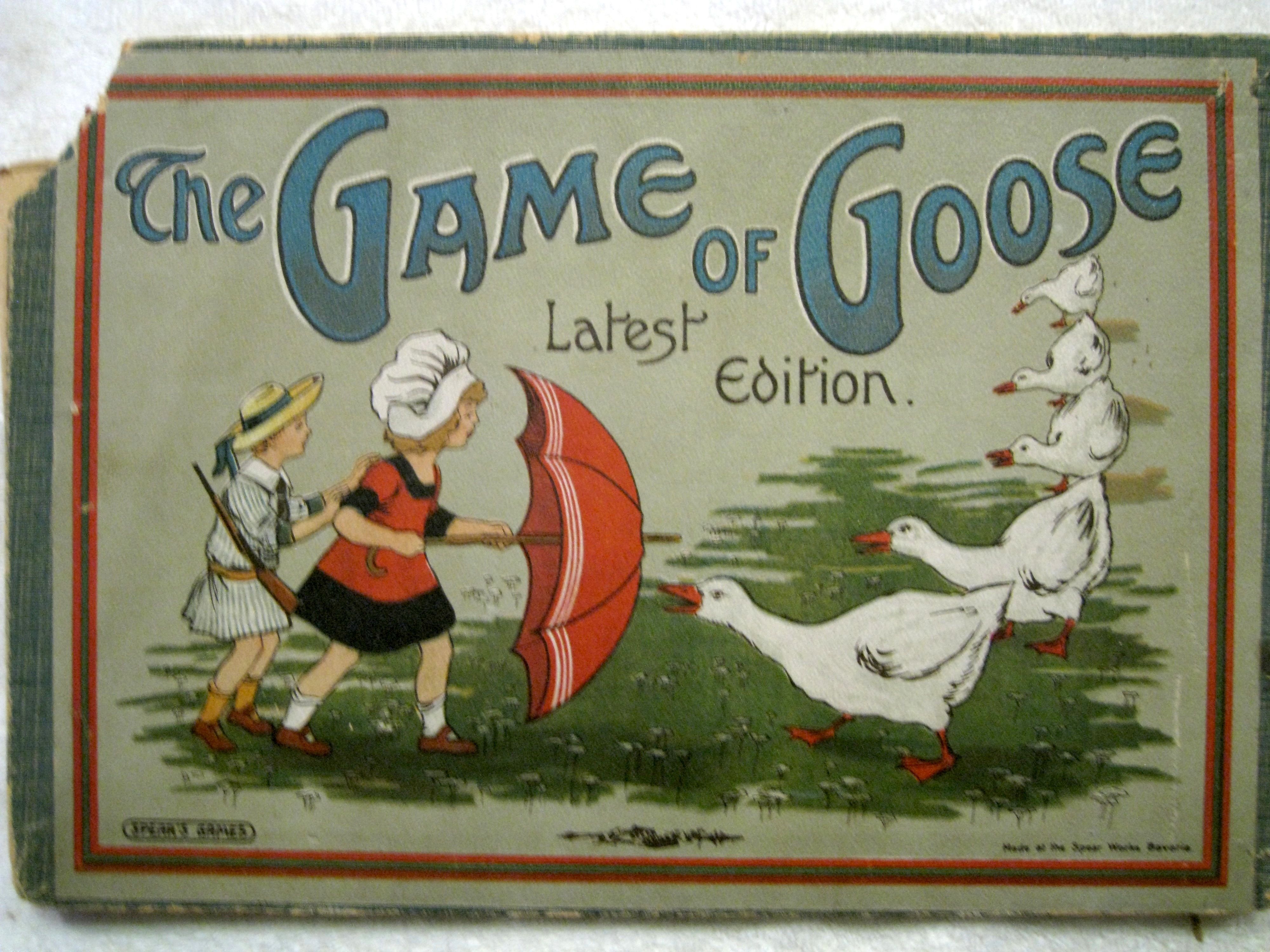
Game of Goose (1587)
2 - 6 persone
20 - 20 min
5+
Al momento questo prodotto non è disponibile presso nessun venditore.
Nomi alternativi: Het Aloude Ganzenspel, Het Apenspel, Auf dem Gänseanger, Comme du Buerre, Il dilettevole Gioco di Loca, Drillepind, Het echt ganzenspel, Het Efteling Spel, Europe Game, Game of Goose, The Game of Goose set around Lake Como, The Game of the Goose, Gänse Spiel, Gänse-Spiel, Gänseliesl, Das Gänsespiel, Gänsespiel, Ganzebord, Ganzenbord, Het Ganzenbord, Ganzenbord 3D, Ganzenbord spelkleed, Gåsespillet, Gåsspelet, Gässpelet, Il Gioco con le Oche, Il Gioco Dell' Oca Dilettevole, Gioco dell'Oca, Il Gioco dell'Oca, Il Gioco dell'Oca del Lago di Como, Il gioco dell'oca di Milano, Il Gioco di Jules Verne, Giuoco dell'Oca, Goose Game, Goosegame, Grand Jeu de L'Oie, Das Grosse Gänse Spiel, Die große Überfahrt: Gänsespiel, Le Jeu d'Oie, Jeu de l'âne Noirmoutier, Jeu de l'Huile de Table des Chartreux, Jeu de l'Oie, Le Jeu de l'Oie, Jeu de l'oie des archives départementales du Gard, Jeu de l'oie du RCCH: Rugby Club Cherbourg-Hague, Jeu de L'oie et Petits Chevaux, Jeu de l'Oie F.C.Grenoble Rugby, Jeu de l'Oie: Pédagogique – Sur la culture du Cacao, Jeu de l'oie: Un petit tour au musée du Louvre, Le Jeu Des Bons Enfans, Jeu du Chemin de Fer ou du Jeu de l'oie ferroviaire, Le Jeu du Crocodile Nîmois, El joc de l'oca, Joc de l'oca, Jogo da Glória, Jogo do Ganso, El juego de la oca, Juego de la oca, Das Khurtzweillige Fortuna-Spill, Das kleine Gänsespiel, Kva-Kvaak hanhipeli, Laurie's New and Entertaining Game of the Golden Goose, Leeuwenspel, Löwenspiel, Das lustige Affenspiel für Jung und Alt, Lustiges Gänse Spiel, Nederlandsch Ganze Spel, Ein Neu-Erfundenes Ganss-Spiel, Das neue Affenspiel, Neues Gänse Spiel, Neues Gänsespiel, The New and Favorite Game of Mother Goose and the Golden Egg, The new and marvellous game of the goose, or, one man's morris-off, Het Nieuw en Vemaecklyck Gansespel, Het nieuwe ganzenspel, Nouveau Jeu De L'Oie, Det nya gåsspelet, La Oca Loca, Oud Hollands Ganzenbord, Het Oud Hollandse Ganzenbord, Oud-Hollands Ganzenbord, Oud-Hollandsch Ganzenbord, Oudhollands Ganzenbord, Het Out-Hollandse Ganzenbord, I personaggi della Commedia, Piggelmee, Piraña wildwaterspel, Reise in die Ewigkeit, Reuze Ganzenbord, The Royal Game of Goose, The Royal Game of the Goose, Royall & most pleasant game of the goose, Het Samson Spel, De school gaat uit, En voyage avec Vauban, Wilde-Ganzenbord, Zodiac Race Classic Game Bandana, Το παιχνίδι της χήνας
Artisti: Su00e9bastien Chebret, Claude Deschamps, Mauro Gariglio, Michael Holzbecher, Yasmin Imamura, Martin Jarrie, Eugen Osswald, Su00e9verine Pru00e9lat, Florence Thuillier
Editori: (Public Domain), (Self-Published), (Unknown), ABC Nu00fcrnberg, Abel Klinger, ABRA, Altap, ASS Altenburger Spielkarten, Berliner Spielkarten, Bookmark Verlag, Borras Plana S.A., Brimtoy, Bru00fcckner Spiele, Carlit, Carlo Coriolani, Carrom Art, Cayro, The Games, Christian Janicot, Chupa Chups, Clementoni, Clown Games, Daniel Mercier Chocolatier & Cru00e9ateur, David Funck, Diabolo, Diset S. A., Djeco, Dominioni Editore, Douwe Egberts, Editions ATLAS, Editrice Giochi, Egel-Spelen, Epinal, ERA Aux Fruits D'Orient, Fratelli Fabbri Editori (Fabbri Editore), Galison, Galleryplay, Galt Toys, Georg Nikolaus Renner, H. Overton, Hausser, HEMA, Inovac Rima SA, J Vlieger, Jeu Jura, Jeux Stella, Johann Raab, Johann Trautner, John Bowles & Son, John Wallis, Jos. Scholz, Jumbo, Kadon Enterprises, Kids Games Ltd, King International, Klee, Koster Brothers, Louvre Editions, Ludens Spirit, Majora, Marigu00f3, Martin Fritz, MB Juegos, MB Spellen, Mon Petit Art, Mulder, Nathan, Nederlandse Spellenfabriek B.V. Amsterdam, Noris Spiele, Nu00fcrburg Spiele, Oehmigke & Riemschneider, Otto Maier Verlag, Palet spil, Papita, Peliko Oy, Pellerin & Cie, Peri Spiele, La Petite Bou00eete, play time, Playbox, R. H. Laurie, Ravensburger, Reader's Digest, Reclame Uitgaven De Beukelaer, Renu00e9 Ackermann, Ricon, Robert Sayer, Role of Honour Games, Rubinstein, Sala, Saussine Editeur, Schmidt France, Schmidt Spiele, Selecta Spel en Hobby, Selecta Spielzeug, Sio, Societu00e0 Editrice Internazionale, Sociu00e9tu00e9 Gu00e9nu00e9rale Polishes, Spear's Games, Tactic, Tietz und Pinthus, Tomland, University Games, Verlag G.N. Renner, Verlag J. A. Steinkamp, Waldpost Spiele-Verlag, Watilliaux, White Horse, Wild Horse, XVIe, Zwan, u0395u03a0u0391 (EPA), u03a4u03bf u039au03b1u03bbu03cc u03a0u03b1u03b9u03c7u03bdu03afu03b4u03b9 u0391.u0395.
Editori: (Public Domain), (Self-Published), (Unknown), ABC Nu00fcrnberg, Abel Klinger, ABRA, Altap, ASS Altenburger Spielkarten, Berliner Spielkarten, Bookmark Verlag, Borras Plana S.A., Brimtoy, Bru00fcckner Spiele, Carlit, Carlo Coriolani, Carrom Art, Cayro, The Games, Christian Janicot, Chupa Chups, Clementoni, Clown Games, Daniel Mercier Chocolatier & Cru00e9ateur, David Funck, Diabolo, Diset S. A., Djeco, Dominioni Editore, Douwe Egberts, Editions ATLAS, Editrice Giochi, Egel-Spelen, Epinal, ERA Aux Fruits D'Orient, Fratelli Fabbri Editori (Fabbri Editore), Galison, Galleryplay, Galt Toys, Georg Nikolaus Renner, H. Overton, Hausser, HEMA, Inovac Rima SA, J Vlieger, Jeu Jura, Jeux Stella, Johann Raab, Johann Trautner, John Bowles & Son, John Wallis, Jos. Scholz, Jumbo, Kadon Enterprises, Kids Games Ltd, King International, Klee, Koster Brothers, Louvre Editions, Ludens Spirit, Majora, Marigu00f3, Martin Fritz, MB Juegos, MB Spellen, Mon Petit Art, Mulder, Nathan, Nederlandse Spellenfabriek B.V. Amsterdam, Noris Spiele, Nu00fcrburg Spiele, Oehmigke & Riemschneider, Otto Maier Verlag, Palet spil, Papita, Peliko Oy, Pellerin & Cie, Peri Spiele, La Petite Bou00eete, play time, Playbox, R. H. Laurie, Ravensburger, Reader's Digest, Reclame Uitgaven De Beukelaer, Renu00e9 Ackermann, Ricon, Robert Sayer, Role of Honour Games, Rubinstein, Sala, Saussine Editeur, Schmidt France, Schmidt Spiele, Selecta Spel en Hobby, Selecta Spielzeug, Sio, Societu00e0 Editrice Internazionale, Sociu00e9tu00e9 Gu00e9nu00e9rale Polishes, Spear's Games, Tactic, Tietz und Pinthus, Tomland, University Games, Verlag G.N. Renner, Verlag J. A. Steinkamp, Waldpost Spiele-Verlag, Watilliaux, White Horse, Wild Horse, XVIe, Zwan, u0395u03a0u0391 (EPA), u03a4u03bf u039au03b1u03bbu03cc u03a0u03b1u03b9u03c7u03bdu03afu03b4u03b9 u0391.u0395.
Descrizione: The Game of Goose is an ancient children's classic, possibly tracing its roots all the way to the Ancient Egyptian game of Mehen which was played in early Old Kingdom times.
Francesco de Medici in Italy sent a copy of this game to King Felipe II of Spain during the 16th century.
It became one of the most popular games in Europe during that time.
Circa 1600, Benoît Rigaud's heirs printed in Lyon "Le Jeu de l'oye, renouvellé des Grecs, jeu de grand plaisir, comme aujourd'huy princes & grands seigneur" [sic] "le pratiquent" - Le jeu de l'oie, renewed from the Greeks, game of great pleasure, as today princes and great lord [sic] play it -, the oldest French copy known.
Father Claude-François Menestrier describes the game in his "Bibliothèque curieuse et instructive" (1704) : 'There's another type of game, that seems easier to learn, and easier to play; it's the game of goose so common and it is said to come from the Greeks, though nothing can be found about it in their authors. This game is much easier than cards game, because it's always wholly displayed to the players, and, being in the form of a snail or spirally folded snake, it's appropriate to print the things that one wants to learn...'.
The game became an instant hit in France in the 1600s, and engendered a lot of variants (educational, commemorative, ...) up to the present day.
It turned up later in England about 1750, according to Whitehouse, under the title "Royall & most pleasant game of the goose - Invented at the Consistory in Rome and are printed and sold by H. OVERTON at Ye White Horse without Newgate where all sorts of Fine Prints and maps are Sold and Framed at Reasonable Rate".
By 1851 it had been copied by the American publisher J.P. Beach of New York who entitled it The Jolly Game of Goose. An 1855 edition was called simply The Game of Goose.
It is a simple game of racing, using a spiral track with lovely illustrations. The main principle is one shared with Snakes and Ladders as well as the later Game of Life: virtue is rewarded and vice is punished.
Schmidt Spiele rates their Gänsespiel for ages 5 and up.
Bibliography
Whitehouse, F. R. B. (1971) [1951]. Table games of Georgian and Victorian days. Birmingham: Priory Press Ltd.
'Jeux de princes, jeux de vilains', edited by Eve Netchine, Bibliothèque nationale de France / Seuil (2009).
--gameplay description from Wikipedia:
The board consists of a track with consecutively numbered spaces (usually 63), and is often arranged in a spiral with the starting point at the outside. Each player's piece is moved according to throws of one or two dice. Scattered throughout the board are a number of spaces on which a goose is depicted; landing on a goose allows the player to move again by the same distance. Additional shortcuts, such as spaces marked with a bridge, move the player to some other specified position. There are also a few penalty spaces which force the player to move backwards or lose one or more turns, the most recognizable being the one marked with a skull and symbolizing death; landing on this space results in the player being sent back to start. On Spanish boards the reverse is usually a Pachisi board.
Many themed versions of the game have been created, depicting topics as diverse as ice skating, Richard Nixon, and sewage pumps. These can be valued for their historical or artistic merits even by those who have no interest in the game itself, with some editions having been sold for thousands of dollars at auction or displayed in museums.
Francesco de Medici in Italy sent a copy of this game to King Felipe II of Spain during the 16th century.
It became one of the most popular games in Europe during that time.
Circa 1600, Benoît Rigaud's heirs printed in Lyon "Le Jeu de l'oye, renouvellé des Grecs, jeu de grand plaisir, comme aujourd'huy princes & grands seigneur" [sic] "le pratiquent" - Le jeu de l'oie, renewed from the Greeks, game of great pleasure, as today princes and great lord [sic] play it -, the oldest French copy known.
Father Claude-François Menestrier describes the game in his "Bibliothèque curieuse et instructive" (1704) : 'There's another type of game, that seems easier to learn, and easier to play; it's the game of goose so common and it is said to come from the Greeks, though nothing can be found about it in their authors. This game is much easier than cards game, because it's always wholly displayed to the players, and, being in the form of a snail or spirally folded snake, it's appropriate to print the things that one wants to learn...'.
The game became an instant hit in France in the 1600s, and engendered a lot of variants (educational, commemorative, ...) up to the present day.
It turned up later in England about 1750, according to Whitehouse, under the title "Royall & most pleasant game of the goose - Invented at the Consistory in Rome and are printed and sold by H. OVERTON at Ye White Horse without Newgate where all sorts of Fine Prints and maps are Sold and Framed at Reasonable Rate".
By 1851 it had been copied by the American publisher J.P. Beach of New York who entitled it The Jolly Game of Goose. An 1855 edition was called simply The Game of Goose.
It is a simple game of racing, using a spiral track with lovely illustrations. The main principle is one shared with Snakes and Ladders as well as the later Game of Life: virtue is rewarded and vice is punished.
Schmidt Spiele rates their Gänsespiel for ages 5 and up.
Bibliography
Whitehouse, F. R. B. (1971) [1951]. Table games of Georgian and Victorian days. Birmingham: Priory Press Ltd.
'Jeux de princes, jeux de vilains', edited by Eve Netchine, Bibliothèque nationale de France / Seuil (2009).
--gameplay description from Wikipedia:
The board consists of a track with consecutively numbered spaces (usually 63), and is often arranged in a spiral with the starting point at the outside. Each player's piece is moved according to throws of one or two dice. Scattered throughout the board are a number of spaces on which a goose is depicted; landing on a goose allows the player to move again by the same distance. Additional shortcuts, such as spaces marked with a bridge, move the player to some other specified position. There are also a few penalty spaces which force the player to move backwards or lose one or more turns, the most recognizable being the one marked with a skull and symbolizing death; landing on this space results in the player being sent back to start. On Spanish boards the reverse is usually a Pachisi board.
Many themed versions of the game have been created, depicting topics as diverse as ice skating, Richard Nixon, and sewage pumps. These can be valued for their historical or artistic merits even by those who have no interest in the game itself, with some editions having been sold for thousands of dollars at auction or displayed in museums.