


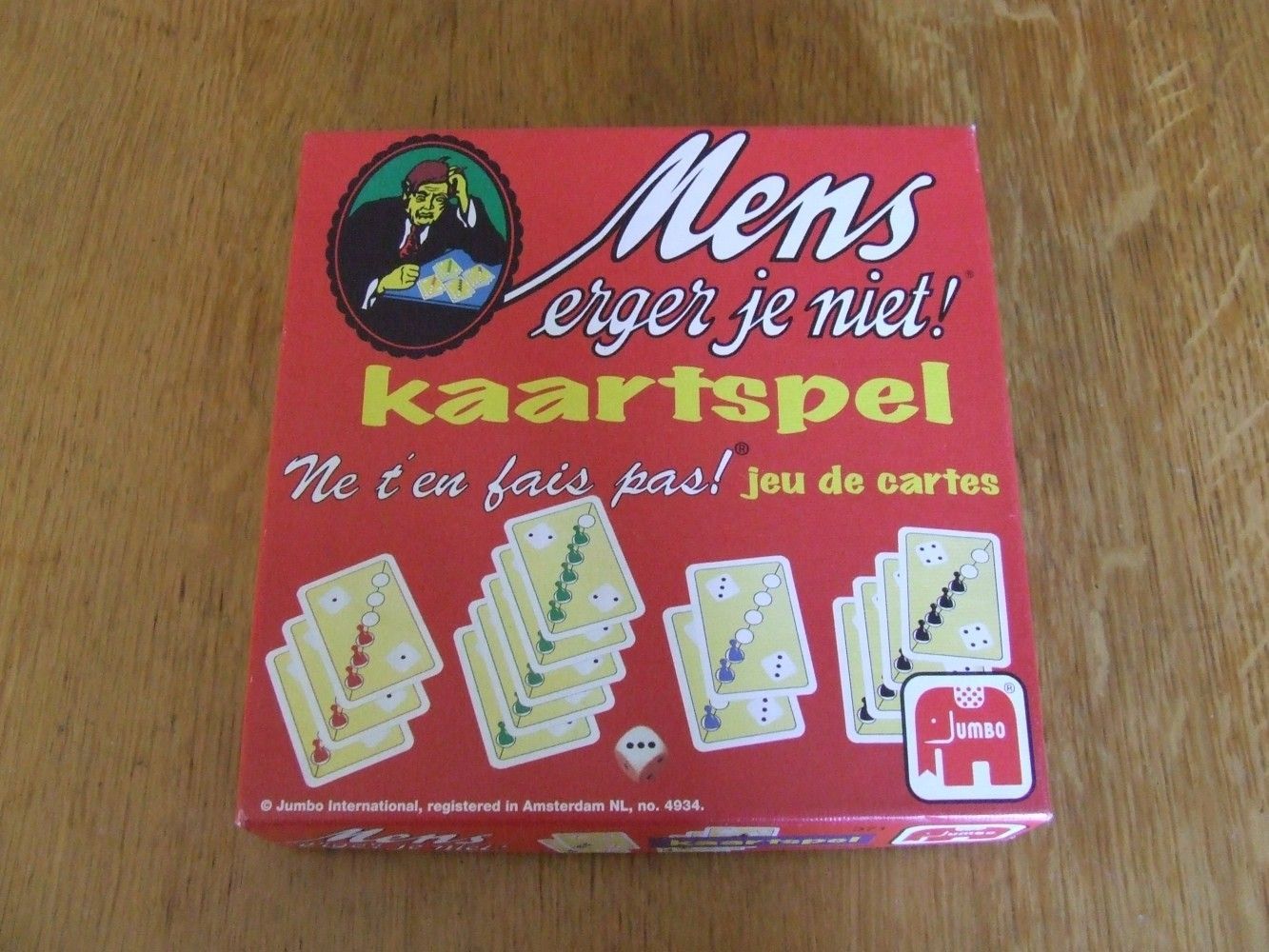
Mens erger je niet!: Kaartspel (1995)
2 - 4 persone
15 - 15 min
6+
Al momento questo prodotto non è disponibile presso nessun venditore.
Nomi alternativi: Mens erger je niet!: Kaartspel, Ne t'en fais pas!: Jeu de cartes
Descrizione: Card version roughly simulating the endgame situation in vanilla "Mens erger je niet!" / "Ne t'en fais pas!" (a "Pachisi" / "Parcheesi" clone), the object being to 'bring the pawns home'.
Each player has an identical pack of 24 cards, in one of 4 colors. There are 4 sets of 6 cards with each set having a die value printed on the cards: 1 through 4. The cards within a set have a number of colored pawns on them, 1 through 6, and have to be played onto their 'home' pile in that order.
The object is to play out all your cards onto the 4 'home' piles while hampering your opponent.
Card play is done "Shut the box" style, where the eyes on a standard D6 determine the total value of cards that may be played onto their 'home' piles. A [6] rolled allows for another die roll and play of cards.
The pawns printed on the cards come into play when hampering the opponent. When one of the 'home' piles -represented by the dice- reaches the same size -represented by the pawns- as the opponent's identical pile, the opponent has to empty that 'home' pile.
Winner is the player who 'brings all pawns home' first.
Each player has an identical pack of 24 cards, in one of 4 colors. There are 4 sets of 6 cards with each set having a die value printed on the cards: 1 through 4. The cards within a set have a number of colored pawns on them, 1 through 6, and have to be played onto their 'home' pile in that order.
The object is to play out all your cards onto the 4 'home' piles while hampering your opponent.
Card play is done "Shut the box" style, where the eyes on a standard D6 determine the total value of cards that may be played onto their 'home' piles. A [6] rolled allows for another die roll and play of cards.
The pawns printed on the cards come into play when hampering the opponent. When one of the 'home' piles -represented by the dice- reaches the same size -represented by the pawns- as the opponent's identical pile, the opponent has to empty that 'home' pile.
Winner is the player who 'brings all pawns home' first.