


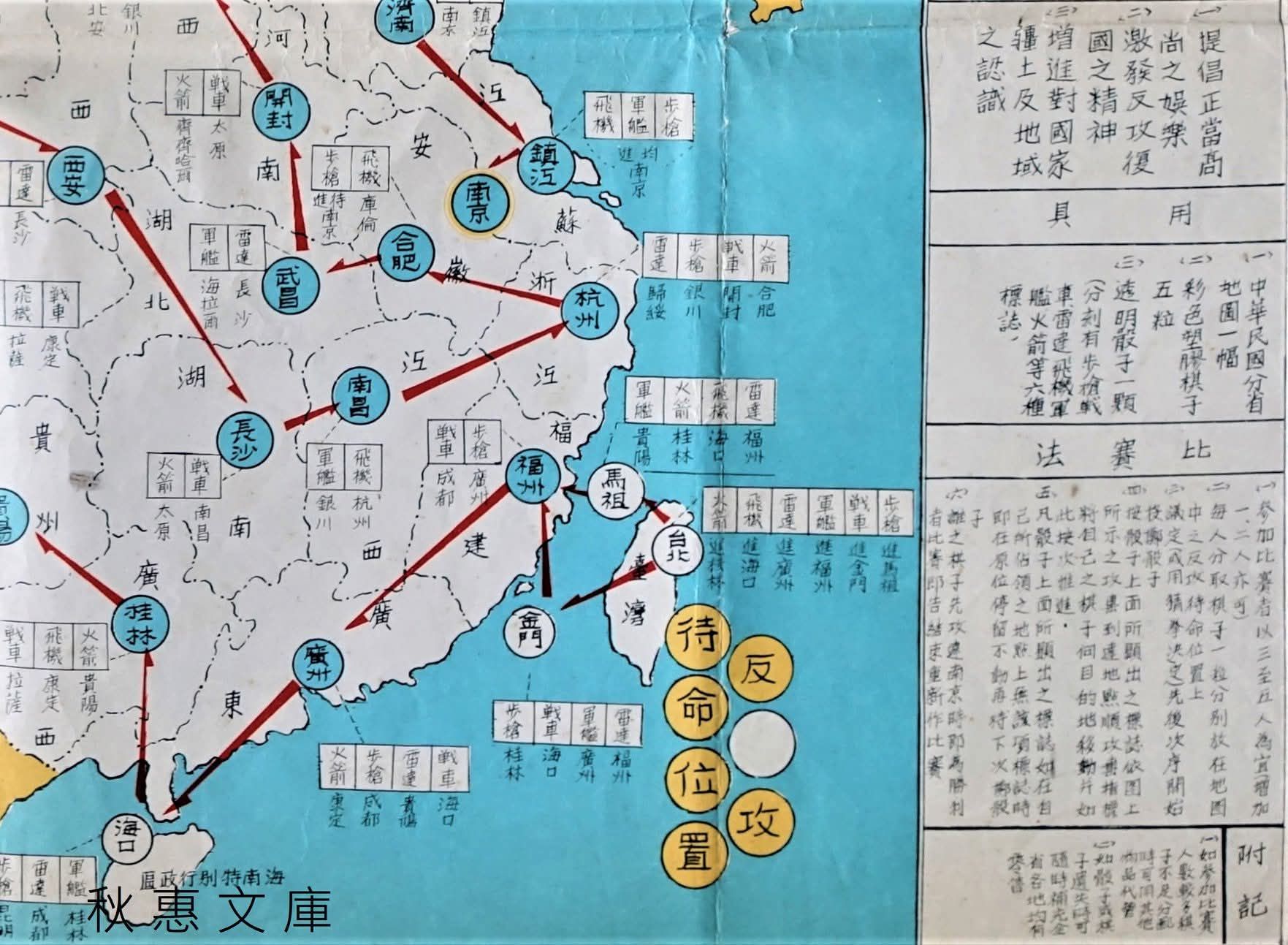
反攻勝利棋 (Counteroffensive Victory Chess) (1965)
2 - 4 persone
15 - 60 min
7+
Al momento questo prodotto non è disponibile presso nessun venditore.
Descrizione: Counteroffensive Victory Chess (光復勝利棋, also known as Fǎngōng Shènglì Qí / 反攻勝利棋) is a 1960s Taiwanese board game produced by the KMT government during the Cold War. It was designed as a propaganda tool to teach children Chinese geography while gamifying the hypothetical retaking of mainland China from the Communist Party.
Gameplay & Rules
The game functions similarly to modern board games like The Game of Life or Snakes and Ladders, relying heavily on luck rather than traditional chess strategy.
Objective: Be the first player to reach Nanjing (the capital of the Republic of China at the time).
Starting Point: All players begin on the island of Taiwan.
Movement: Players roll dice to move through various Chinese provinces.
The Route: A typical path might start in Taipei, move through Kinmen or Matsu, then Fuzhou, and loop through various major cities (e.g., Guangzhou, Chengdu, Lhasa, Shenyang) before finishing in Nanjing.
Unique Historical Features
The board map reflects the geopolitical worldview and predictions of the 1960s Taiwanese government:
Unified Neighbors: Both Korea and Vietnam are depicted as unified, non-communist nations.
Independent Territories: Kashmir is shown as an independent nation, and Bangladesh is still labeled as Pakistan.
Mongolia: The map includes Outer Mongolia as part of the territory to be "retaken," as the ROC government did not recognize Mongolian independence at the time.