


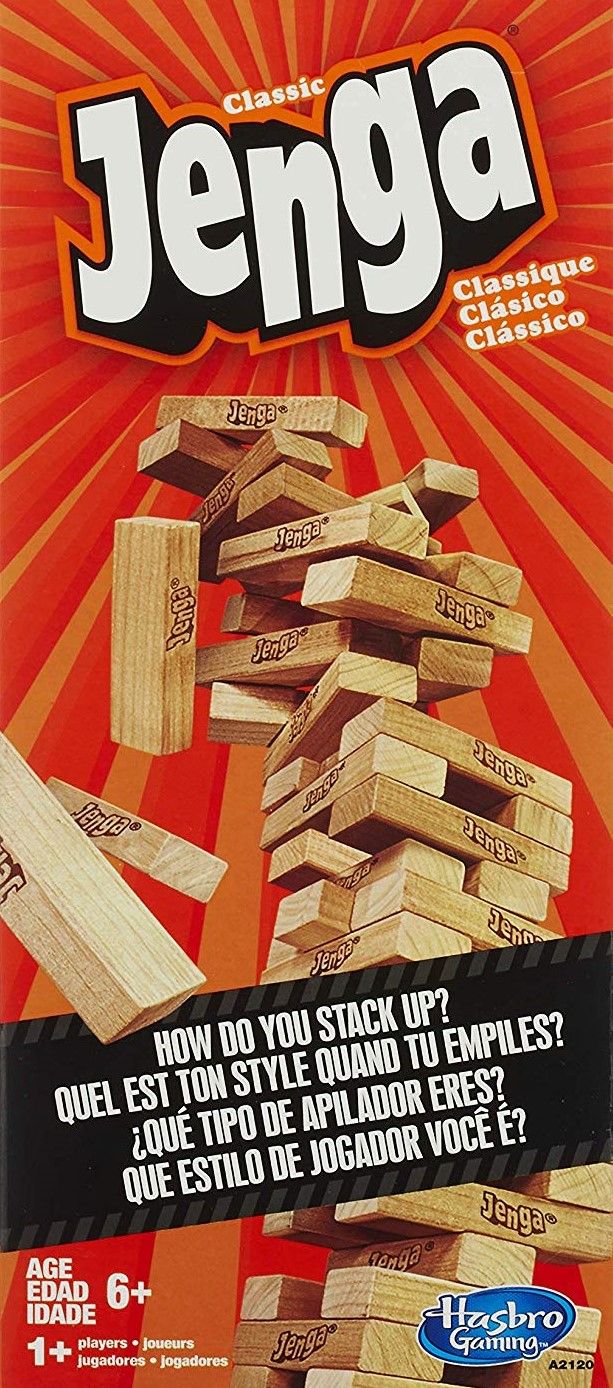
Jenga (1983)
1 - 8 persone
20 - 20 min
6+
Al momento questo prodotto non è disponibile presso nessun venditore.
Nomi alternativi: Balance Tower, Block a Block, Bugs Building, Classic Jenga, Dhilema, Hoppla Nature, Huojuva torni, Jenga, Jenga Giant, Jenga Mark II, Jenga: National Parks Edition, Jenga: Nightmare Before Christmas Collector's Edition, Jenga: Scooby-Doo! Edition, JENGA: Tim Burton's The Nightmare Before Christmas Travel Edition, Jiggle Tower, Jinga, Jumbling Tower, Klodsmajor, LATTJO Stacking Game, Look Out!, Mini Timber Tumble, Miombo Tumble Tower, Plock Bygg & Ras!, Prumo Gigante, Red High Rise, Stack 'em, Stack The Carrots, Stapelspel, Tenka, Tension Tower, Terremoto, Tilt!, Timba!, Timber, Timberrr: A Game of Balance, Tip-Tower, Toppling Tower, Torenhoog, Torre, Torre de Madera, Torre Equilíbrio, Torre Pendente, Torre Tambaleante, Torre Treme-Treme, Torremoto, Tour Chancelante, Tour folle, Tower, Tower Up, Towering! Blocks, Tumble, Tumble Tower, Tumbling Tower, Turmania, Det Vaklende Tarn, Wackelturm, Wiss toy, Wood Tower, Башня, Башня с фантами «Бам-бум», ג'נגה, ジェンガ, 젠가, 탑탑, 펭귄 스택
Editori: (Unknown), Barnes & Noble, Borras Plana S.A., Brinquedos Junges, Cayro, The Games, Chad Valley Co Ltd., Challenge Master Game Co Ltd, Creative Crafthouse, Dal Negro, Early Learning Centre, Estrela, Flying Tiger Copenhagen, Fratelli Fabbri Editori (Fabbri Editore), Full Base Union Enterprise Co., Ltd., Fundex, Go! Games, Goki, Grow Jogos e Brinquedos, Der Gru00fcne Punkt, Hasbro, Hearth & Hand with Magnolia, IKEA, Inspirion, Irwin Toy Ltd., John Jaques of London, Klee, Korea Boardgames, Lagoon Games, Leslie Scott Associates, MB Juegos, MB Spiele, Melco, Meridian Point Products, Milton Bradley, Mitra, NeoTroy Games, Noris Spiele, Okou00efa-Addendo, The Op Games, OPEN'N PLAY, Paradigm Games Ltd, Parker Brothers, Pavilion, Planet Finska, Pokonobe Associates, Publijuego, Queen Games, Salco, Santa Teresa, Schmidt France, Siam Mandalay, Simba Toys, Skybound Tabletop, Spin Master Ltd., SPM: Syarikat Permainan Malaysia, Stihl, Tactic, Tesco, Tomy, Top-Game, Top-Toy, tridias, Woodstock Spiele, WWF, u0414u0435u0441u044fu0442u043eu0435 u043au043eu0440u043eu043bu0435u0432u0441u0442u0432u043e
Riconoscimenti: 2003 Japan Boardgame Prize Best Japanese Game Nominee, 2015/Spring Parents' Choice Recommended
Descrizione: A tower building game.
Jenga is played with 54 wooden blocks; each block is 3 times as long as it is wide, and slightly smaller in height than in width. The blocks are stacked in a tower formation; each story is three blocks placed adjacent to each other along their long side, and each story is placed perpendicular to the previous (so, for example, if the blocks in the first story are pointing north-south, the second story blocks will point east-west). There are therefore 18 stories to the Jenga tower. Since stacking the blocks neatly can be tedious, a plastic loading tray is included.
Once the tower is built, the person who built the tower moves first. Moving in Jenga consists of taking one and only one block from any story except the completed top story of the tower at the time of the turn, and placing it on the topmost story in order to complete it. Only one hand at a time may be used to remove a block; both hands can be used, but only one hand may be on the tower at a time. Blocks may be bumped to find a loose block that will not disturb the rest of the tower. Any block that is moved out of place may be left out of place if it is determined that it will knock the tower over if it is removed. The turn ends when the next person to move touches the tower, although he or she can wait 10 seconds before moving for the previous turn to end if they believe the tower will fall in that time.
The game ends when the tower falls in any significant way -- in other words, any piece falls from the tower, other than the piece being knocked out to move to the top. The loser is the person who made the tower fall (i.e. whose turn it was when the tower fell); the winner is the person who moved before the loser.
The same game concept was published in 1984 by Fagus under the name "Hoppla - eins zuviel!"
According to the designer, the game was developed from Takoradi blocks/bricks. "Jenga" is Swahili for "build".
Jenga is played with 54 wooden blocks; each block is 3 times as long as it is wide, and slightly smaller in height than in width. The blocks are stacked in a tower formation; each story is three blocks placed adjacent to each other along their long side, and each story is placed perpendicular to the previous (so, for example, if the blocks in the first story are pointing north-south, the second story blocks will point east-west). There are therefore 18 stories to the Jenga tower. Since stacking the blocks neatly can be tedious, a plastic loading tray is included.
Once the tower is built, the person who built the tower moves first. Moving in Jenga consists of taking one and only one block from any story except the completed top story of the tower at the time of the turn, and placing it on the topmost story in order to complete it. Only one hand at a time may be used to remove a block; both hands can be used, but only one hand may be on the tower at a time. Blocks may be bumped to find a loose block that will not disturb the rest of the tower. Any block that is moved out of place may be left out of place if it is determined that it will knock the tower over if it is removed. The turn ends when the next person to move touches the tower, although he or she can wait 10 seconds before moving for the previous turn to end if they believe the tower will fall in that time.
The game ends when the tower falls in any significant way -- in other words, any piece falls from the tower, other than the piece being knocked out to move to the top. The loser is the person who made the tower fall (i.e. whose turn it was when the tower fell); the winner is the person who moved before the loser.
The same game concept was published in 1984 by Fagus under the name "Hoppla - eins zuviel!"
According to the designer, the game was developed from Takoradi blocks/bricks. "Jenga" is Swahili for "build".