


Go-Moku (700)
2 - 2 persone
5 - 5 min
8+
Al momento questo prodotto non è disponibile presso nessun venditore.
Nomi alternativi: 5 på stribe, Amőba, Comoko, Fem på Stribe, Five in a Row, Fünf in einer Reihe, Gewinn mit 5, Gin Checkers, Go & Gobang, Go Bang, Go Und Gobang, Go-Bang, Go-Moku, Go-Muku, Go+Gobang, Gobang, Gomoku, Gomoku-narabe, Jätkänshakki, Kreuzeln, Luffarschack, Wu Zi Qi, 五子棋
Editori: (Public Domain), (Unknown), ABRA, Alga, Arxon, ASS Altenburger Spielkarten, Copp Clark Publishing Company, Duu00e0n De Lu01d0 (u6bb5u7684u7406), Grubbe Media GmbH, IQ Products, Jian Lun (u5251u4f26), John Jaques of London, John W. Hill & Co., Jumbo, L. P. Septu00edmio, Otto Maier Verlag, Palet spil, Schmidt International, Shuu0101ng Hu00f3u (u53ccu7334), Spear's Games, Watilliaux, Werner & Schumann, u03a4u03bf u039au03b1u03bbu03cc u03a0u03b1u03b9u03c7u03bdu03afu03b4u03b9 u0391.u0395.
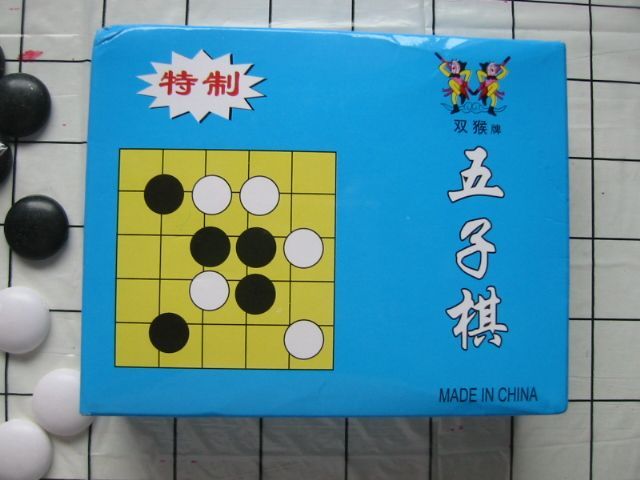
Descrizione: "Go-Moku" (Japanese - also spelled "Gomoku") or "wuziqi" (Chinese) is a very old game played with a Go set. The game can also be played on a sheet of graph paper using X's and O's. It is similar in idea to tic-tac-toe, but far greater in scale and complexity. The name means "five points."
It is debated whether this game originated in China or Japan, with more evidence pointing to the former.
The object is to get five stones in a row. The game is played on a 19x19 board (such as the board used in Go), creating a large and open field to complete this objective. The game can also be played on a smaller board, such as the popular 15x15 option.
If played perfectly, Black (who goes first) can always win the game. Even before this was proven, the game was recognized to be easier for Black. This problem is solved in Renju. which is often seen as the adult contemporary to the kids' Go-Moku.
It is debated whether this game originated in China or Japan, with more evidence pointing to the former.
The object is to get five stones in a row. The game is played on a 19x19 board (such as the board used in Go), creating a large and open field to complete this objective. The game can also be played on a smaller board, such as the popular 15x15 option.
If played perfectly, Black (who goes first) can always win the game. Even before this was proven, the game was recognized to be easier for Black. This problem is solved in Renju. which is often seen as the adult contemporary to the kids' Go-Moku.