


Round 'N' Round (1977)
2 - 4 persone
0 - 0 min
0+
Al momento questo prodotto non è disponibile presso nessun venditore.
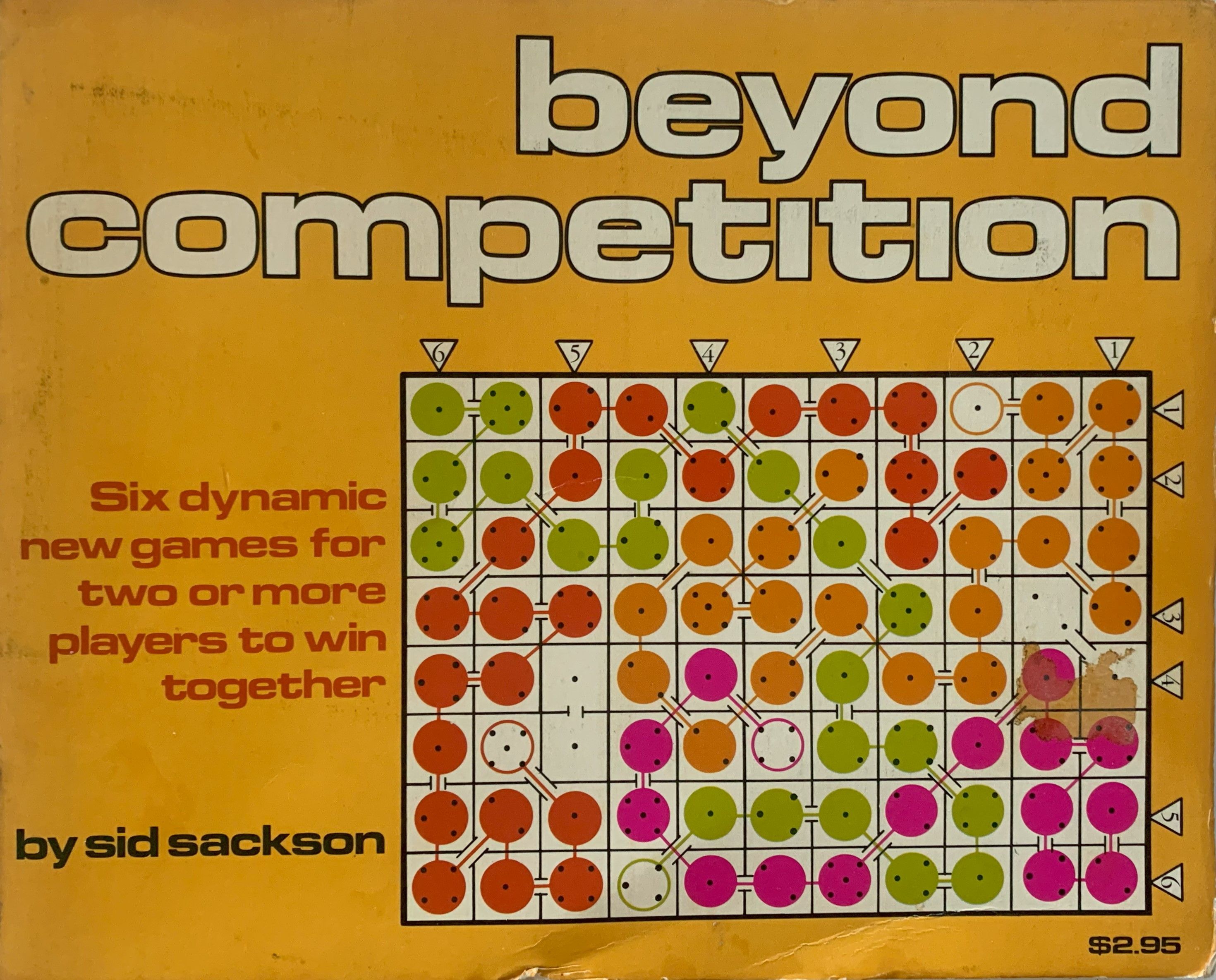
Descrizione: Round 'N' Round is a cooperative paper-and-pencil game that appeared in Sackson’s book Beyond Competition. The playing field shows a winding, coiled track of spaces. The game uses a deck of 24 cards (4 each of values 1-6). 4P game, each P uses a different colored pencil (or 2 can play, each controlling two different colors). To start, each player draws a card. Starting from the innermost space (the one marked with an X), the player who drew the highest colors in that many consecutive spaces in his color. The other players do the same in reverse order of the number drawn. Then six cards are dealt in a row. On a player’s turn, they may select the card at either end of the row and fill in that many consecutive spaces on the track. When there is only 1 card remaining, deal out 5 more to the right of it. When the deck is depleted, reshuffle and deal out cards until there are six.
There are two rows of boxes above the playfield – a “+” row and a “=” track. Each time you color a square, if you form a line of adjacent spaces of that color (not including diagonally), fill in that many spaces on the “-“ track. If you form a line of 3 adjacent spaces (not including diagonally) of three different colors, color ONE space of the “+” track. If you reach the end of the “+" track before you get to the end of the “-“ track, you win. If you reach the end of the “-“ track, you lose. If reach the end of the main track before you reach the end of the “+” or “-“ track, whichever track you were farthest ahead on determines if you win or lose.
There are two rows of boxes above the playfield – a “+” row and a “=” track. Each time you color a square, if you form a line of adjacent spaces of that color (not including diagonally), fill in that many spaces on the “-“ track. If you form a line of 3 adjacent spaces (not including diagonally) of three different colors, color ONE space of the “+” track. If you reach the end of the “+" track before you get to the end of the “-“ track, you win. If you reach the end of the “-“ track, you lose. If reach the end of the main track before you reach the end of the “+” or “-“ track, whichever track you were farthest ahead on determines if you win or lose.